R&D CORPORATION "AGAT"
P.L.KAPITZA INSTITUTE FOR PHYSICAL PROBLEMS
RUSSIAN MEDICAL MICROTRONS
MOSCOW, RUSSIA
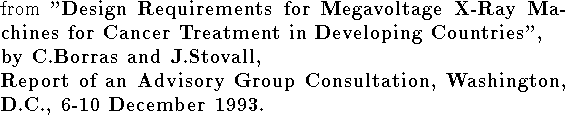
According to World Health Organization estimates, there are currently
approximately 9 million new cancer cases per year, worldwide. This number is
expected to increase to about two-thirds of these cases occurring in
developing countries.
Radiotherapy will, for years to come, be the most important therapy approach
for most of these tumors, both for cure and palliation...
Most nonindustrialized countries perform radiation therapy primarily with
 treatment machines. This has been and in many cases continues
to be the technology of choice because these machines are relatively
reliable and are simple to operate and repair. However, the radioactive
source is often not replaced for economic reasons, leading to ineffective
treatments. Also, these countries often do not have the infrastructure to
ensure the safe disposal of the source.
treatment machines. This has been and in many cases continues
to be the technology of choice because these machines are relatively
reliable and are simple to operate and repair. However, the radioactive
source is often not replaced for economic reasons, leading to ineffective
treatments. Also, these countries often do not have the infrastructure to
ensure the safe disposal of the source.
It is estimated that in developing countries approximately 2,300 megavoltage
teletherapy units are currently installed, primarily units. In these
countries, the typical incidence of new cancer patients is 75 to 150 per
100,000 population. To serve a current population of 4.4 billion, assuming
4.4 million new cancer cases per year, 50% of which requiring radiotherapy,
and assuming one machine per 500 new cancer cases treated, the current need
is for a total of 4,400 machines. By the year 2015, barring a dramatic and
unforeseen cure for cancer, a total of 10,000 machines will be needed...
Most radiation oncology departments in the U.S. and in Europe use mainly
linear accelerators, which offer a variety of treatment modes and contain no
radioisotopes. Some of these units are very expensive and difficult to
maintain, and the infrastructure to use them properly is often lacking in
developing areas. Thus, for the purpose of improving the availability
of radiation therapy, manufacturers and major laboratories are being
encouraged to consider the design and development of megavoltage x-ray
machines that would be much simpler than present microwave electron linear
accelerators...
The competitive types of the electron accelerators for the medical
application are linacs and microtrons.
The microtron is a compact cyclic electron accelerator. In its
classical variant the microtron has a constant and homogeneous magnetic field
and an accelerating RF voltage usually with wavelength  . The electron trajectory in the microtron is a system of increasing in
diameter circles with common point where the accelerating cavity is placed.
. The electron trajectory in the microtron is a system of increasing in
diameter circles with common point where the accelerating cavity is placed.
The microtron is an accelerator usually pulsed. It is
necessary to excite the accelerating cavity by a rather high pulse microwave
power. The conventional microtron operates with repetition rate 50 -
1000 Hz and pulse length of some microseconds; an average power of
accelerated beam is some kW and with an energy from 5 up to 40 MeV. The size
and weight of the microtron are comparatively small -- the diameter of the
magnet is 0.3-1.5 m, the weight -- 600-1500 kg depending on the final
electron energy.
The striking advantage of the microtron is its simplicity. The
precision of the microtron cavity does not present any particular
difficulty. The construction of the magnet for the microtron is also
simple and the energy losses in it are minimal. The construction and
parameters of the RF system of the microtron, except the
accelerating cavity, are the same ones in standard radar
stations.
Due to its simplicity, high efficiency, high resolution electron beam
of a small size, small angular divergence, almost 100% extraction
efficiency, a microtron is used for solving a lot a scientific
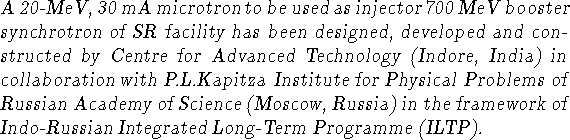
and applied problems: as an electron beam injector for higher energy
accelerators; as a electron, x-ray and neutron source for nuclear,
solid-state and relativistic electronics research; for radiography of
thick-wall industrial construction; for isotope production; for
radiochemistry and radioactivation analysis; et cetera...
Cancer treatment
machines is one of the promising applications of the microtron. All factors
being the same, the microtrons have a number of advantages over linacs:
better electron energy spread; better stability of the energy; lower electric
and microwave power consumption; a simpler cooling system; simpler
maintenance. These factors lead to a low-cost of production of the
medical microtrons as well as to a low-cost of maintenance, including a
replacement of components of the apparatus.
The R&D Corporation "AGAT" (Moscow, Russia) has been developing the
effective medical microtrons since late 70's. The base of the
apparatus is the microtrons developed in the P.L.Kapitza Institute for
Physical Problems RAS. The pilot model of the medical microtron "Microtron
M22" at energy 22 MeV was installed in the Hertzen Research Institute of
Oncology in Moscow. It has been used both for photon and for electron cancer
treatment since 1985. Recently more than 10.000 patients have been treated
including over 200 patients treated by the new and effective
intra-operational method. The industrial manufacturing medical microtrons
are also installed in the Medical Radiological Institute (Obninsk, 1993), in
the Institute of Oncology and Radiology (Minsk, 1993), in the Estonian Cancer
Center (Tallinn, 1993), in the Ukrainian Cancer Center (Kiev, 1996)
and in the Moscow Region Research Clinical Institute (1997).
Recent research and development on modern effective medical
microtrons are conducted by the "AGAT" in collaboration with the
Kapitza Institute.
Some characteristics of the developed
medical microtrons are presented in the following table.

New computer based treatment-planning systems have been developed which can
be used for the medical microtrons as for many types of radiotherapy
machines.
The following steps
for the medical microtron development are in the progress:


With attention to the envisaged increase in demand for
radiation therapy worldwide, especially in the developing countries, the
"AGAT" R&D Corporation and the Kapitza Institute for Physical Problems
offer:
-- international cooperation for the development of low-cost,
effective and reliable medical microtrons --
-- establishing joint ventures for production of medical
microtrons --
Contact addresses
R&D Corporation "AGAT",
105275, shosse Entuziastov, 29/53, Moscow, Russia.
Dr. A.R.Mirzoyan, Chief Designer,
Tel. (095)-273-36-72, FAX (095)-273-41-30.
P.L.Kapitza Institute for Physical Problems
of Russian Academy of Sciences,
1117134, Kosygina str., 2, Moscow, Russia.
Prof. S.P.Kapitza, Leading Scientist
E-mail:
S.Kapitza@kapitza.ras.ru ,
Dr. G.D.Bogomolov, Senior Scientist,
E-mail:
bogomolov@kapitza.ras.ru,
Tel. (095)-137-65-77, FAX (095)-938-20-30.